
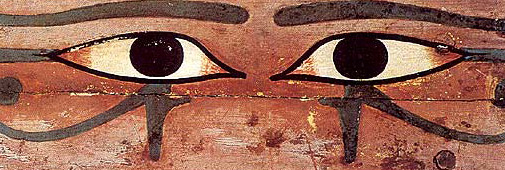
Symbols have been an integral part of human civilization since time began for humanity. They hold immense power, conveying deeper meanings and connecting us to ancient wisdom and beliefs. Two symbols, that are still popular today, are the eyes of Ra and Horus; which we’ll examine in this post.
Horus and Ra in Mythology
Ra and Horus are the focal points of a few of the oldest stories ever told. Horus is the son of the god and goddess Osiris and Isis. Ra, on the other hand, is the Egyptian sun god.
Each of them is connected to the very roots of Ancient Egypt and mythology. They’re each responsible for conveying only one side of a whole story. These stories are incredibly important to our history because they attempt to explain the universe, gods, and man.
The Story of Horus
In Egyptian mythology, Horus was one of the most significant gods, often depicted as a falcon-headed deity. He was considered the god of protection. For that reason, he played a central role in the religious beliefs and practices of the ancient Egyptians.
The origins of Horus can be traced back to the pre-dynastic period of ancient Egyptian history, when he was worshipped as a local deity in the region of Upper Egypt. Over time, Horus grew in prominence and was eventually integrated into the overarching pantheon of Egyptian gods and goddesses.
Horus was the son of the god Osiris and the goddess Isis, and his birth and life were intertwined with tales of triumph and revenge. This is, in part, due to the roles and history of his parents. For Horus, his greatest mission in life was to seemingly restore order for his family.
Horus’ Family History
If you’ve ever watched the Disney movie the Lion King, the story of Osiris, his brother, Set, and his son, Horus, is eerily similar. Imagine Osiris as Mufasa, Set as Scar, and Horus as Simba. This film for children helps us understand the dynamic between these Ancient Egyptian gods.
Horus’ father, Osiris, was the lord of the underworld and the god of the dead. He was famously murdered by his brother Set, the god of chaos and darkness. Set’s reasoning was because he was jealous of his brother’s power, which led him to trick him and then drown him in the Nile River.
Isis searched for her husband, Osiris, endlessly; finding the remains of his body scattered in different places. When she finally found them all, she was able to resurrect Osiris, although it was only temporary. Fortunately, it was enough time to conceive their son, Horus, who would later avenge his father’s death.
Cosmic Conflict of Horus and Set
After Osiris’ death, Set usurped the throne and proclaimed himself the ruler of Egypt. Horus, as the legitimate heir, engaged in a long and arduous battle to reclaim his father’s kingdom. The cosmic conflict between Horus and Set is the focal point of Horus’ story.
It revolves around his epic struggle against his uncle, Set, for the rightful kingship of Egypt. Set and Horus engaged in a series of challenges and contests to prove their worthiness to rule. These contests included a boat race and a series of trials that tested their abilities.
Ultimately, Horus emerged victorious in the struggle against Set, defeating him in combat and proving himself to be the rightful king of Egypt. The story of Set and Horus is a central theme in Egyptian mythology. It highlights the eternal struggle between good and evil, order and chaos, and the quest for power and legitimacy.
The Story of Ra
Although Ra’s story is much less exciting, it’s also a bit more elusive. Ra is a hawk-headed deity, who was also the creator of the universe, according to Ancient Egyptian mythology. He is most well-known, however, as the sun god.
Ra was considered the king of the gods and the most important deity in the Egyptian religious system. He was believed to be the responsible for the source of all life. According to Egyptian mythology, Ra was responsible for the daily cycle of the sun, rising in the east and setting in the west, and was thought to be reborn each morning, symbolizing the cycle of life, death, and rebirth.
Ra was seen as the divine ruler of Egypt. The pharaohs, who were considered the earthly representatives of the gods, often associated themselves with Ra and claimed to be his descendants. This connection between the pharaohs and Ra helped to legitimize their rule and reinforce their “divine” right to govern.
Ra was also the focus of numerous myths and legends that explored his role as the creator and sustainer of the universe, as well as his ongoing struggle against the forces of chaos and darkness. These myths were frequently used to explain the cycle of the sun and the changing of the seasons, as well as to provide a framework for the Egyptians’ understanding of the world and their place within it.
Horus and Ra in Symbolism
In symbolism, the left side is associated with negative, feminine energy. Conversely, the right side is connected to positive, masculine energy. The eye of Horus is the left eye, while the eye of Ra is the right eye.
The Eyes of Horus and Ra are associated with feminine and masculine energy. When brought together, they reveal the nature of humanity, which has both positive and negative qualities. Likewise, they represent that what goes up, must come down, or “on earth, as it is in heaven.”
The significance of the eyes have profound theological and metaphysical connections. The Eye of Ra represents the active, masculine principle of the sun god, who is responsible for the creation and maintenance of the universe. The Eye of Horus embodies the restorative, feminine principle of healing the wounds inflicted by the forces of chaos.
Feminine Principles
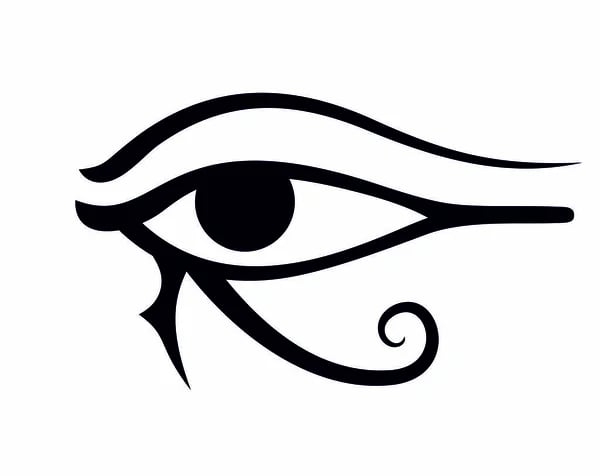
The Eye of Horus is positioned on the left side of the body, which was traditionally associated with femininity. This placement is significant, as the left eye of Horus was said to have been gouged out during his legendary battle with Set. Like Horus’ mother had done with his father, the goddess of love and motherhood, Hathor, had restored his eye.
Therefore, his mother, Isis, resurrected Osiris and became pregnant with Horus. Later, Horus lost his eye, which was given back to him by the goddess of motherhood, Hathor. This shows us another connection between Horus and the feminine energy of the left side.
The Healing Gaze of the Eye of Horus is also called the “Wedjat” or “Udjat” eye. This intricate symbol represents the healing, protection, and restoration of the divine order. It’s also associated with the eye that sees the truths of the world, enabling him to see beyond the mundane and perceive the hidden.
As Osiris, his father, was the god of the underworld, Horus may have a natural affinity for seeing beyond the veil of life. Likewise, as Horus’ eye had technically died and been brought back to life, the eye deepened its connection with the other side. As a result, the left eye of Horus is oftentimes seen as the “dark” eye.
Masculine Principles
The Fiery Gaze of the hawk-headed sun god, Ra, is also known as the “All-Seeing Eye.” This potent symbol represents the divine authority, power, and watchfulness of Ra, who was believed to oversee the cosmic order and ensure the continued flourishing of the universe.
Positioned on the right side of the body, the Eye of Ra is often depicted as emanating the scorching rays of the sun. This placement is significant, as the right side of the body was traditionally associated with masculinity, strength, and positive energy.
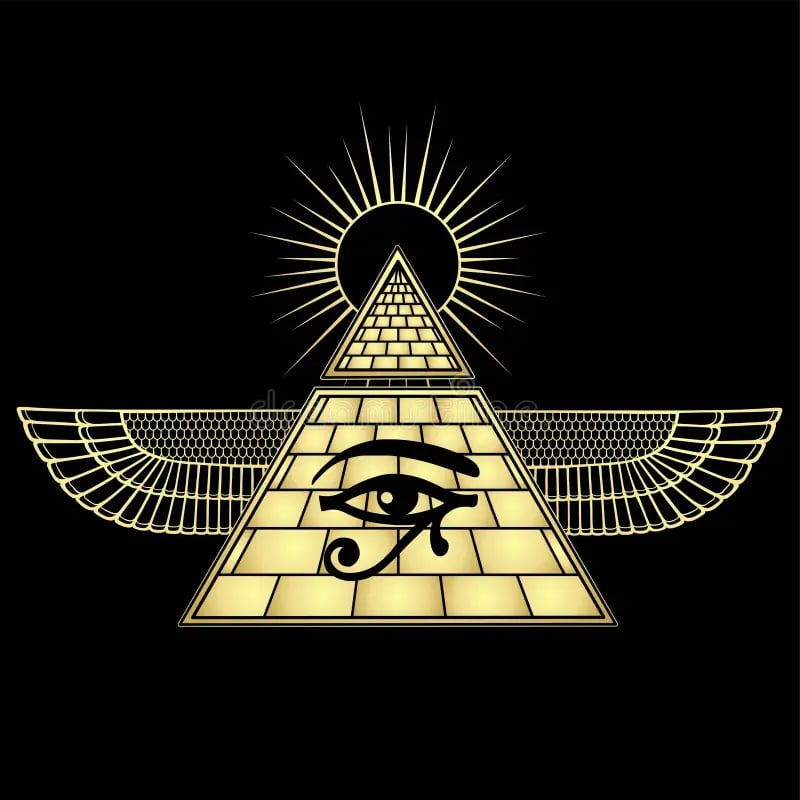
These two powerful eyes, when viewed together, create a harmonious balance between the opposing yet complementary forces of the divine realm and the realm of humanity. They serve as a reminder that true harmony and prosperity can only be achieved when the masculine and feminine principles are in perfect alignment, and when the forces of light and dark, creation and restoration, are kept in delicate equilibrium.
In the end, the Eye of Ra and the Eye of Horus are not merely symbols of ancient Egyptian mythology; they are timeless archetypes that continue to resonate with us today, offering insights into the enduring quest for balance, healing, and perseverance.
References:
- Budge, E. A. Wallis. The Gods of the Egyptians: Studies in Egyptian Mythology. Dover Publications, 1969.
- Andrews, Carol. Amulets of Ancient Egypt. University of Texas Press, 1994.
- Wilkinson, Richard H. The Complete Gods and Goddesses of Ancient Egypt. Thames & Hudson, 2003.
- Pinch, Geraldine. Egyptian Mythology: A Guide to the Gods, Goddesses, and Traditions of Ancient Egypt. Oxford University Press, 2004.
- Hart, G. (2005). The Routledge Dictionary of Egyptian Gods and Goddesses. Routledge.
Leave a Reply
You must be logged in to post a comment.