
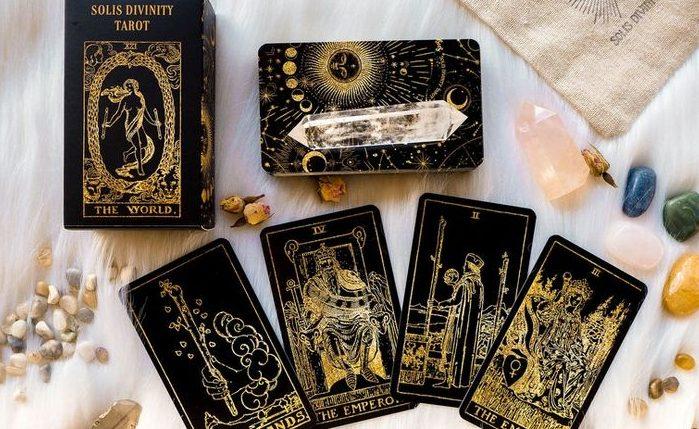
Before we dive into the Suit of Wands within tarot, it’s important that we first understand the two, main parts of the deck. These two parts are what is known as the Major Arcana and the Minor Arcana. The Suit of Wands can be found as one of the four suits contained within the Minor Arcana.
The Suit of Wands, Suit of Pentacles, Suit of Swords, and Suit of Cups are what make up the Minor Arcana. As already mentioned in a previous post, the four suits within the Minor Arcana each represent an element. Obviously, these elements are air, water, fire, and earth.
Likewise, each one is symbolically linked to an integral part of every day, human experience. These are thoughts, feelings, actions, and materials. Today, however, we are focusing on the Suit of Wands.
Symbolism of the Suit of Wands
Representing the fire element, the Suit of Wands regard our actions. That means that each wand card indicates something involving our actions taken. Some of these cards are positive, while others feel more negative.
The Suit of Wands, however, is much more than simply action. It’s also the suit of passion, creativity, and ambition. Wands cards may also represent things like lust and impulsivity or energy and drive.
Sometimes the wands hint at lust, rather than love. Other times, they may pinpoint what currently ignites our inner flame. This is due to the Suit of Wands being symbolically linked to the fire element.
As seen in Harry Potter, Lord of the Rings, and other stories where there are wizards, wands are tools used for magical purposes. They help to direct the flow of energy to a single point. Although they may often appear to be sticks in the cards, the idea is the same. Wands are used to create.
Suit of Wands and Fire
Interestingly, fire can both keep us warm during a cold night, or it can burn us and cause pain. This is similar to the passionate and action-driven side of human nature. When our metaphorical fire goes out, we feel uninspired and unimaginative. Whenever it’s lit, we feel fueled and alive!
Symbolically, fire is about willpower, creation, and passion. The Suit of Wands represents the very same things. When we have “a fire lit under our asses” we feel driven to perform a task and our ego either tells us that we can succeed or that we can’t. Fire is also relative to desires, the self, and the ego.
Fire can set an entire forest ablaze in hardly any time. Our anger can similarly cause us to become chaotic. Energy and passion are much like raging flames.

Suit of Wands Interpretations
Like all the suits, the Suit of Wands has a total of fourteen cards within it. The first ten are numbered ace (one) through ten and the last four are Court Cards. Although each wand card has a meaning that follows the idea of action, passion, and creation, each one is different.
Let’s take a look at their most basic meanings below.
The Suit of Wands Cards
Ace of Wands: Spark of inspiration; initiating adventure; drive toward personal power.
Two of Wands: setting new goals; creating personal boundaries; integration of ego and soul.
Three of Wands: Having the courage to make lifestyle changes or accept opportunities.
Four of Wands: Unexpected means to celebrate; child-like wonder and optimism; freedom.
Five of Wands: Test of strength; disagreements and trifles that lead to irritation and stress.
Six of Wands: Finding relief and confidence; being prideful; seeking recognition; assertion.
Seven of Wands: Needing to go head-to-head to prove oneself; defending oneself; defiance.
Eight of Wands: Victory in sight; feeling the need to act quickly; feeling a bit on edge.
Nine of Wands: Opposition; needing to find strength; gut feelings warnings of danger.
Ten of Wands: A need to lighten the load; overwhelmed; exhaustion; ask for help.
Page of Wands: Creative opportunity; new passion emerging; messenger of primal world.
Knight of Wands: Falling prey to someone’s false charm; being impulsive and thoughtless.
Queen of Wands: Being mature and self-assured, but never cocky; highly independent.
King of Wands: Abundance of spiritual and creative energy; focused intentions and risks.
Leave a Reply
You must be logged in to post a comment.