
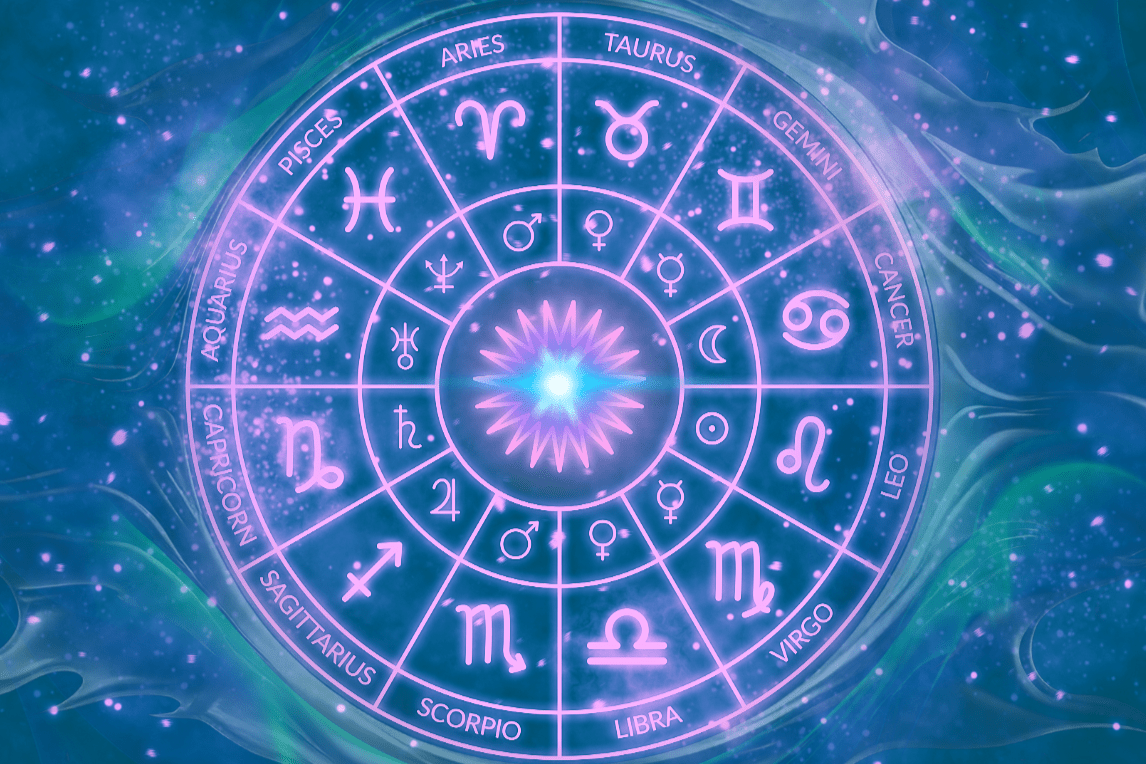
Overview of the Houses
For me, the houses are my favorite area of astrology! They are an extremely important part of anyone’s chart, and a pleasant surprise to discover when learning more about astrology. Today, I’m going to explain to you how they operate, where they are, and more.
Astrology House Location
To begin, we first need to know a bit about the zodiac. If you didn’t know, Zodiac Signs are part of fixed constellations, which means they do not move! Instead, as the signs stay in place, the planets move around within them (relative to human perception), while the houses metaphorically move counterclockwise.
The houses themselves are not physical locations in space. Instead, they are a representation of the earth moving on its axis in the opposite direction in which planets orbit. To sum this up more simply, the houses move left, the planets move right, and the signs remain in place.
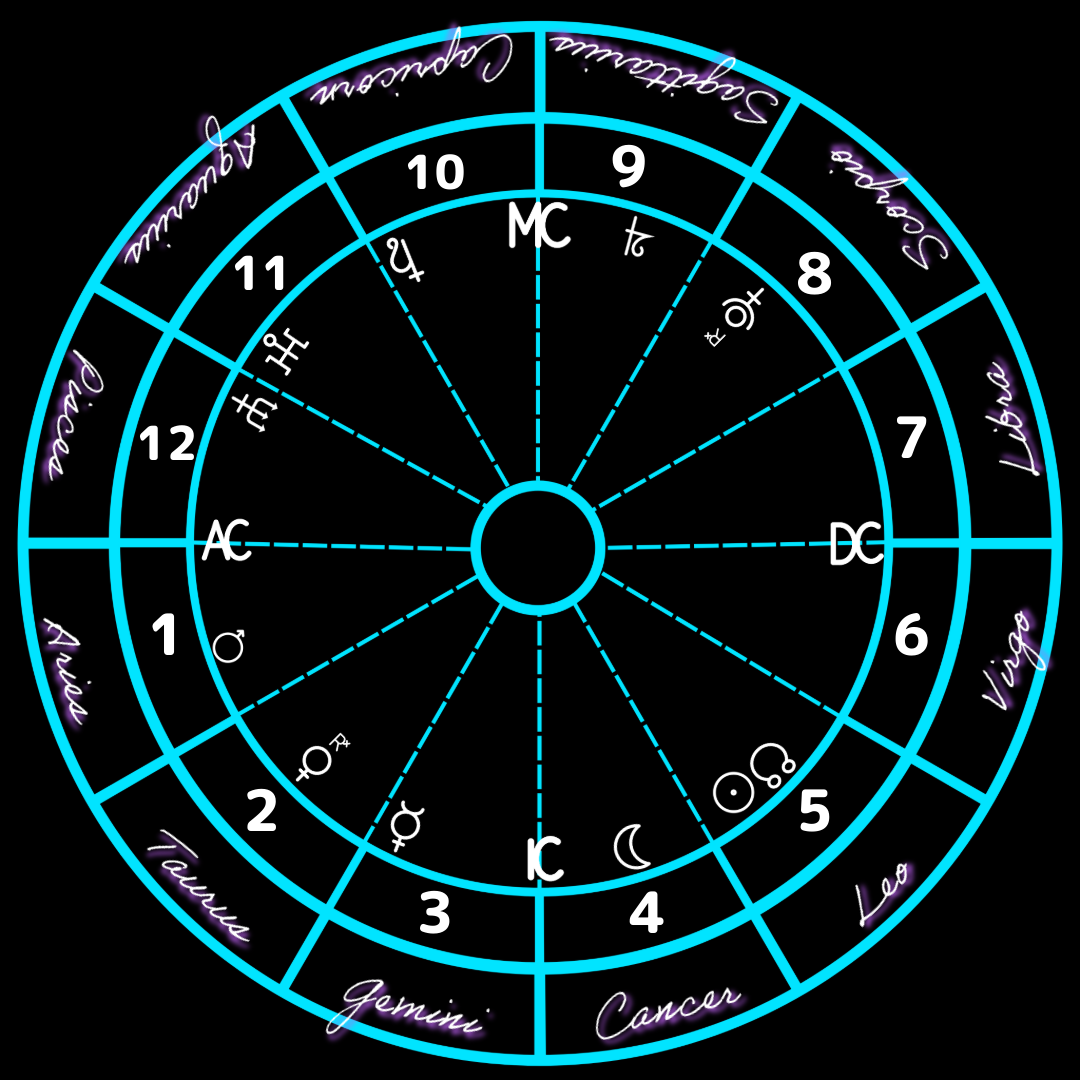
Turn your attention toward the middle of the wheel in the image and find the numbers 1-12. The way the wheel works is that everything inside the lines on both sides of each number are inside the house. For example, you can see that the moon is in the first house, while the sun is in the seventh house, along with the planet Uranus. Next to it, the sixth house contains Jupiter, Mercury, and Venus.

Astrology House Interpretation
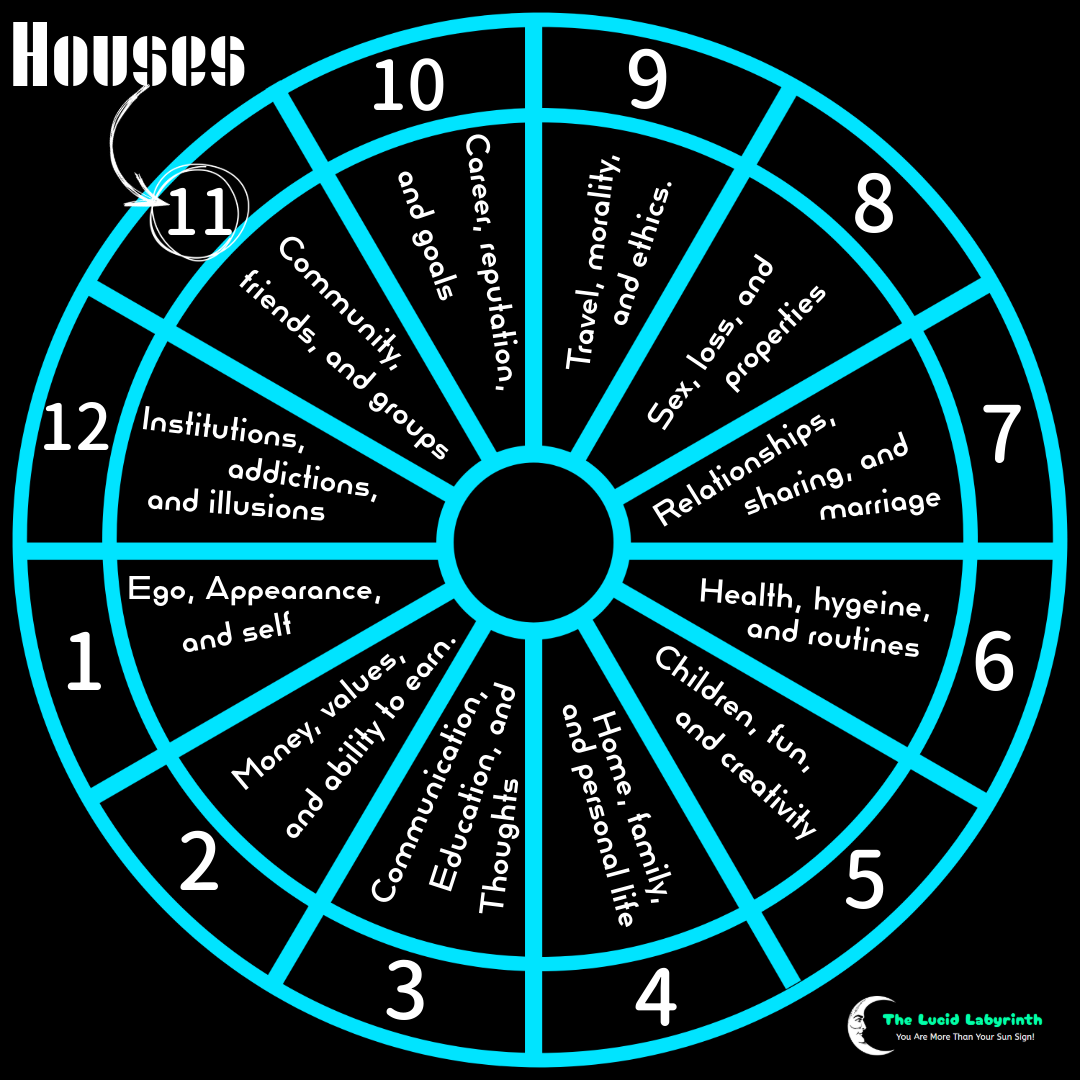
There are twelve houses in Astrology and each one is completely different from the next. Just as there are twelve zodiac signs, naturally, each of them rules a house. The first house is ruled by Aries, the second house Taurus, and so on. Therefore, they share similarities to the sign that rules it, but they have different purposes. For example, Cancer prefers comfort and safety, while the fourth house that it rules relates to the home and family.
Unlike the signs, the houses can show us a timeline of events in our lives, where we express certain parts of our personality, and specific areas of our lives. For example, while the first house represents the self, its opposing house, the seventh house is indicative of others. Likewise, the houses often suggest the types of experiences we have, such as deaths and losses, as seen by the eighth house.

Fixed Zodiac Signs
Now, keep in mind that just because Aries rules the first house doesn’t mean that’s the sign that will rule your personal first house. Remember that I said earlier that the signs are fixed, while the houses metaphorically move counterclockwise. In fact, the houses and signs rarely line up evenly or perfectly.
Any of your personal houses can be in any of the twelve signs. For example, my personal first house is in Cancer. It’s also possible for you to have more than a single sign governing a house. With that being said, you may even have your natal moon in Leo in the third house and Saturn in Virgo in the third house, for example. That’s two planets, two signs, but once house.
Counterclockwise Houses
In the image above, take a look at the empty circle in the center of the wheel. Let’s pretend that that dot is you from your perception point as you stand on Earth. When you look out at the marvelous night sky, you may see thousands of stars.
Many of those distant stars are parts of the constellations of the zodiac. Now, turn to the left for a 360-degree view of the entire sky, as if you’re in a 2D world, like our astrology wheel. This is how the houses move through the constellations.

Clockwise Planets
Lastly, while keeping in mind that the signs are fixed, and you’re the houses moving counterclockwise, let’s add planets. Imagine that as you turn toward your left, you’re passing through the signs. Meanwhile, the planets move by you, opposite the direction you turn.
Pretend that you see Jupiter approaching you around the 12 o’clock position. That would mean that the planet Jupiter is entering your tenth house. Then, you rotate 180 degrees from there to 6 o’clock and see Neptune. So, Neptune would is entering our fourth house.
House Groups
To make it easier to interpret, the houses can be split up into several types of groups. For now, let’s split them up into groups of two. These two groups are based on personal and interpersonal parts of our lives. Both of them have a total of six planets in each with the first half being on the bottom and the second half is at the top.
The first group includes houses 1-6, where the experiences are personal. This is the group of houses that involve the self, which is why they’re on the bottom, as they represent what’s below the surface. These six houses relate to what is strictly personal, as the name suggests.
The second group includes houses 7-12, where the experiences are interpersonal. This is the group of houses that involve others, the public, and interpersonal relations. The reason that these six houses are on the top of the chart is because the experiences here are based on sharing and being involved with anything external, as the name conveys.
Introversion & Extroversion
Interestingly, astrologers are generally able to tell whether a person is introverted or extroverted based on the locations of the planets within their natal chart. Whenever a chart is dominated by planets residing in the personal houses, 1-6, they’re likely to be introverted. Conversely, having the majority of the natal planets in the interpersonal houses, 7-12 indicate that the person is an extrovert. Having an even, or close, distribution of the planets on the top and bottom of the wheel suggests the individual is balanced between self and others.
Leave a Reply
You must be logged in to post a comment.